


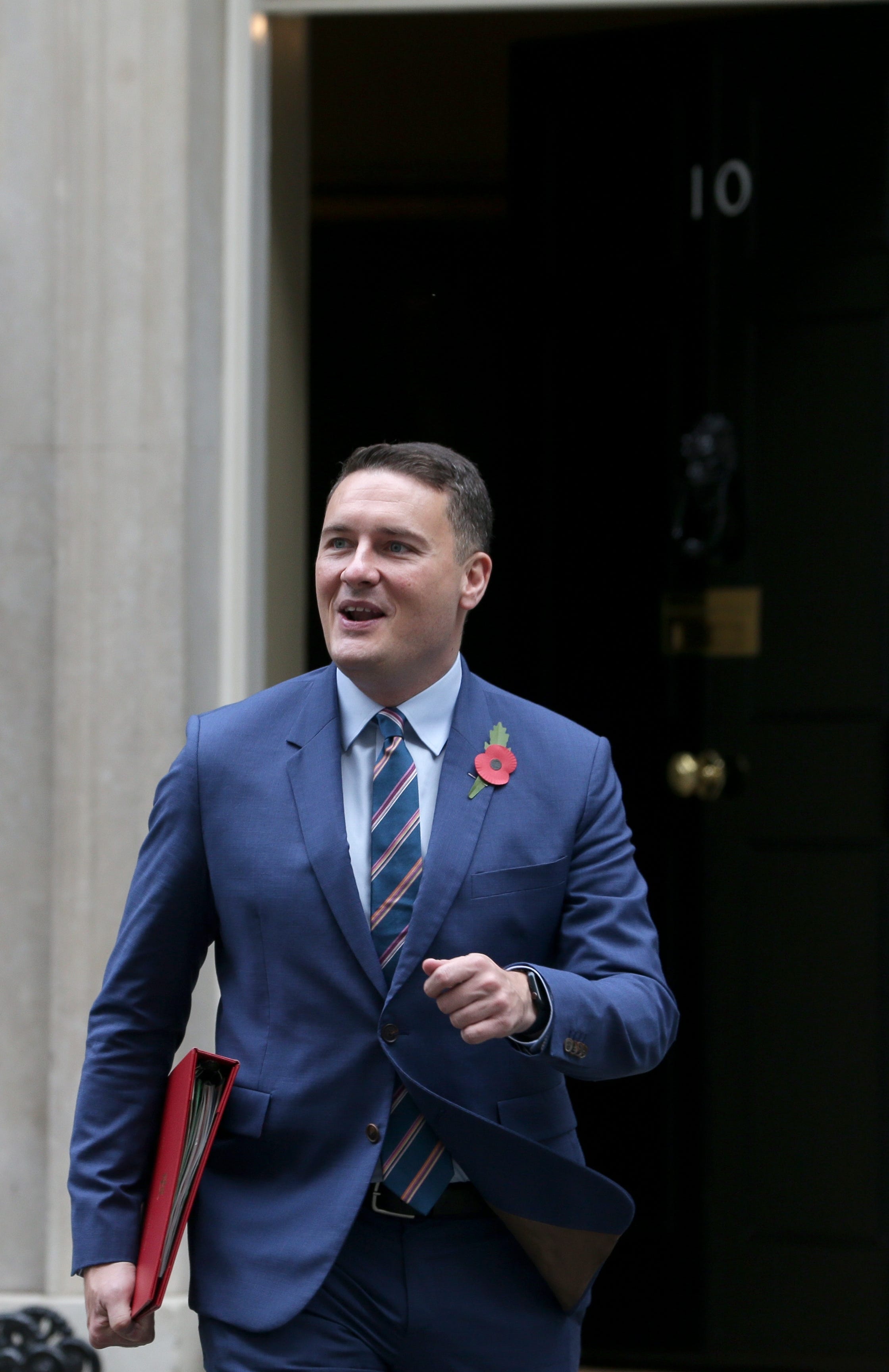
Buried 21 paragraphs deep into a Times report on Keir Starmer’s imminent removal as Britain’s prime minister is an unusually enlightening off-the-record quote.
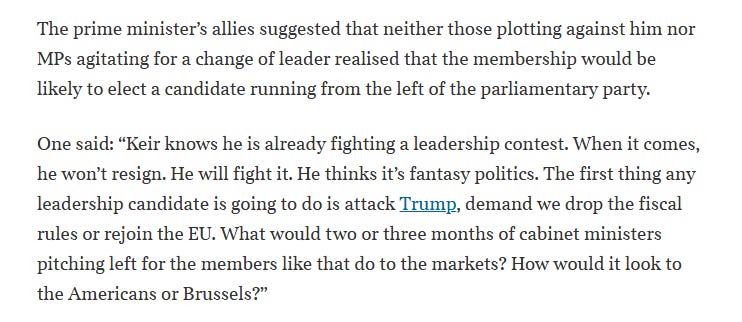
That’s so telling. Since when was re-joining the “bosses’ club” a priority of the “left”? Tony Benn, the Labour left’s post-Sixties icon, was profoundly eurosceptical and would have campaigned for Brexit in 2016 had he lived two more years. It was his Socialist Campaign Group’s great misfortune that, by the time it captured the party a year after Benn’s death, Labour’s membership and electorate realised it was europhile after all.
Speaking on Tuesday - the day a Starmer briefer warned health secretary Wes Streeting against launching a coup - what could this “ally” have meant?
It all slots into place once you understand what motivates Morgan McSweeney, the prime minister’s chief of staff and éminence rouge. It was McSweeney who supposedly licensed the briefing against Streeting. And it was McSweeney whose first call after a shouting match with the health secretary was to Maurice Glasman – the pro-Brexit “Blue Labour” guru who considers McSweeney “one of ours”. Understand McSweeney’s political tradition and you understand Starmer’s stubborn and self-defeating “not in my lifetime” approach to returning the UK to Europe’s single market – the 30-nation European Economic Area (EEA).
It turns out that, for the five years since Starmer took charge, Labour’s leadership has been in thrall to a very particular and long-forgotten party strain: Shoreism. Peter Shore was on the Labour right during its 1979-97 wilderness years and especially during its 1980s meltdown over unilateral nuclear disarmament. But he was also the trade secretary who tried in vain to renegotiate the terms of British accession to the European communities and then campaigned for Brexit at the 1975 referendum. This kind of left Gaullism has a home across the Channel but is uncommon here.
To the Shoreist-Glasmanist cellule at the top of the party and their globalist hangers-on, it makes sense to regard re-convergence with the EU as a priority only for the Woke metropolitan elite. But it isn’t. Settling for nothing short of re-accession to the EU would be, and would also miss the point of how incidental the union part of European Union is becoming to European integration. A roadmap back to the EEA isn’t an elite obsession but it’s also no silver bullet. In common with many EEA members, the UK needs profound structural and fiscal reform and a culture-war settlement. But a concerted three-year effort to restore the benefits and not just the obligations of regulatory twinning with the EEA would boost business and household confidence. It would turn the 2029 election into a referendum over more than just fiscal retrenchment and migration and, I’m sorry to break this to the true Blue bros, it would be popular with party members and more than half the electorate.
Accentuate the positive
It’s worth repeating that just because a third of the electorate plans to vote for Nigel Farage’s Reform UK doesn’t mean Brexit is popular. People consider it a “failure” by 62/31%, regret their 2016 vote by 56/32% and support a return to the EEA by 49/22% (admittedly excluding 28% of “don’t knows”), according to polls. A survey of Labour Party members conducted in September identified their three policy priorities: a wealth tax for the top 1% of earners (25%), a return to the EEA (22%) and an end to the two-child cap on welfare benefits (21%).
For Streeting, who comes not from the left but from the party’s Blairite right, the warning at the top is a political gift. Instead of fruitless competition with ministers Shabana Mahmood (home office), John Healey (defence), Ed Miliband (energy security), former deputy leader Angela Rayner, and a Campaign stooge over degrees of fiscal austerity and migration control, he could give the centre-left something to look forward to for once. An EEA roadmap would appeal not just to party members but to the electorate’s big centre who now bounce between Liberal Democrats, moderate Conservative MPs they like, Greens and abstention.
As Streeting, who represents a Leave-voting constituency in east London, told the Remainiacs podcast in 2019 before post-Brexit omertà descended upon the party: “Even in those areas that voted Leave, I think Labour MPs will be surprised at the extent to which their majorities have been dependent on Remainers. I think that’s been lost in this debate. I’m really fed up with hearing from the same MPs who are the self-appointed voices of the entire north while MPs like Bridget Phillipson and Phil Wilson in places like Sunderland and Sedgefield, which also heavily voted Leave, are speaking up for Labour voters in their area who voted Remain. And yet it’s like these people don’t exist. It’s like we’ve got this homogenous place called ‘The North’ where everyone voted Leave and wants out. It’s just not true”.
To update this assertion, by the way, note that while Reform won a parliamentary byelection in Runcorn and Helsby (in northwest England 10 miles from my home town) in May 2025 by six votes, 49% chose Labour, the Greens or Liberal Democrats. The north isn’t a Faragiste blob.
“The Labour Party is at its heart a pro-Remain party,” said Streeting in the same podcast. “It’s a passionately pro-European party and that’s reflected not just in our membership, our MPs, but also our voters. We saw at the European elections [in 2019] what happens when the Labour Party tries to sit on the fence and look both ways. It wasn’t just that voters abandoned us in significant numbers and that Jeremy Corbyn aided the revival of the Liberal Democrats. For me, the most damning thing was that four in ten Labour Party members didn’t vote Labour … We can’t afford for that to happen again”.
While a leadership campaign with an EEA roadmap would be galvanising, it would need more to close the deal. Don’t “attack” Donald Trump but take a note from Mark Carney in Canada and stop the sucking up. It’s demeaning and doesn’t even yield sustained policy gains since Trump’s opinion will swing depending on the last person he spoke to or the latest Fox News report. Don’t drop the fiscal rules but make them simpler to follow and monitor and not contingent on forecasts from the Office for Budgetary Responsibility. Unless they target the political untouchables of property valuations or inheritance, wealth taxes don’t often work. But, then again, they’re not meant to. They’re a punishment for being rich and a virtue signal to the left. A performative “wealth tax” should form part of the kind of consistent and credible budgetary effort that Starmer has signally failed to deliver. It would have the added utility of providing a nice wedge to cause trouble for Farage and the Tories in 2029.
If Starmer isn’t removed by spring, regional and local election results in May will do the job soon afterwards. His replacement won’t be a caretaker but a prime minister for three years - otherwise known as a full Australian term - so the campaigns should be poetry as well as prose. To see off a RefCon government in 2029, they need to offer much more than a crackdown on illegal immigration or non-credible spending promises and competitive tax increases. Give us a glimpse of sunny upland. Having been disappointed by charismatic politicians before, I hold to the Redskins’ advice (“Take no heroes, only inspiration”). Based on his past views, Streeting is the perfect vehicle to take advantage of the obvious failures of neo-Shoreism. But, if it can’t be him, let it be someone else on that sorry front bench.